

The Thought Leadership Listening Problem
by: Anthony Marshall | July 11, 2026
Earlier this year, the Global Thought Leadership Institute published its first major research report, Promise and Peril: How attitudes to and practices in thought leadership are changing in the era of AI. Drawing on surveys of 1,000 executive consumers of thought leadership and 359 organizations that produce it.
The headline findings were striking: 97% of executives said thought leadership helps them make better decisions. 95% said they made a purchase decision based on thought leadership in the previous quarter. The total value of influenced corporate spending was estimated at $265 billion a year in the US alone.
Those findings make one thing clear: Thought leadership is not peripheral. Done well, it shapes executive decisions, builds trust, and motivates commercial outcomes.
But the GTLI study also raises a more uncomfortable question: Are thought leadership producers listening closely enough to what executives really value?
On the surface, convergence between what business leaders want and what thought leadership producers provide is reassuring. Both groups put depth of insight and analysis at the top of their respective lists. There’s broad agreement that thought leadership must begin with serious thinking, not just attractive content or puff opinions.
But after that, the rankings begin to diverge in ways that should give every thought leadership producer pause.
Business leaders rank originality and uniqueness of perspective third. Thought leadership producers rank it fifth. Executives rank the actionability of recommendations fourth. Producers rank it seventh. Most strikingly, executives rank the extent to which content is AI-generated fifth as a quality concern. Producers rank it last.
This divergence is a signal.
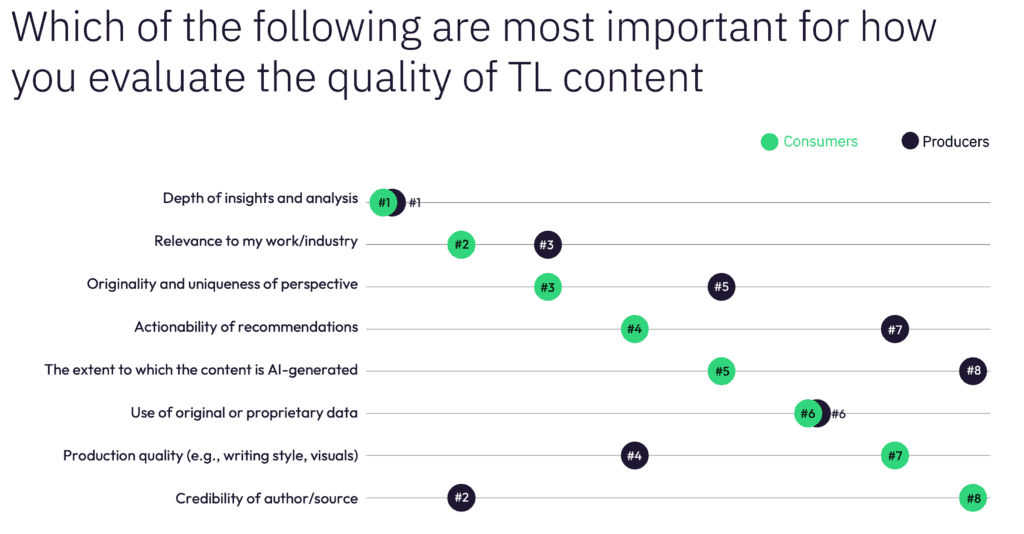
The issue isn’t that producers don’t care about quality. In my conversations with colleagues across the industry, thought leadership producers care about quality deeply. More fundamentally, it’s about what “quality” actually means.
Thought leadership producers can easily become over-absorbed by the mechanics of creating the work: the research process, editorial standards, credibility of authors, quality of writing, style of design, reviews, approvals, and launch plans. All these things matter. But they’re not where consumers of thought leadership start.
Business leaders start with a more practical question: “Does this content help me decide what to do next?”
A report can be beautifully produced and still fail. It can be credible and still be forgotten. It can be elegantly written and still say nothing distinctive. It can scratch an itch for internal stakeholders and still be invisible in the external market.
In some ways, this is the key occupational hazard in producing thought leadership. The closer we are to the process of producing content, the easier it is to confuse effort with impact.
Executives are not asking for more polished sameness. They’re looking for insights relevant to the challenges they face. They want content that’s original enough to reframe their thinking – and practical enough to influence their actions. They want evidence. They want perspective. They want recommendations that go beyond “leaders should” – that actually help them determine what to do differently.
Findings on AI are especially important. AI has already changed thought leadership production, and it will change it further. AI accelerates research, identifies patterns, supports analysis, drafts content, personalizes outputs, and improves distribution. It makes strong teams faster and more effective.
But AI does not replace expertise. Business leaders want to know that thought leadership content has been shaped by genuine insight, experience, and knowledge—not merely assembled through AI automation. AI can support the process, but it’s not a substitute for distinctive thinking.
Source Global Research’s 2026 Quality Ratings Report makes a similar point: “firms are getting lost in a sea of sameness.”
Indeed they are.
Producers that add to that sameness waste their investment. Time and money. They won’t achieve their objectives. The way to win is to break the mold – to offer something genuinely original, useful, and compelling.
Convergence is not distinction.