

Promise and Peril: How attitudes to and practices in thought leadership are changing in the era of AI
by: GTLI Research Team | January 20, 2026
Executive summary
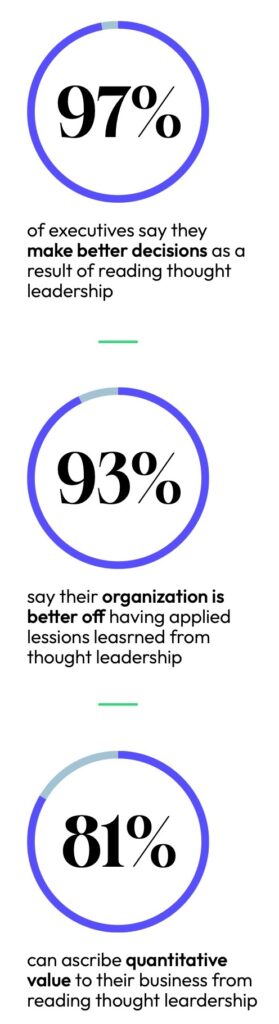
Thought leadership has never been more important: 97% of business executives say they make better decisions as a result of reading it, 93% say their organizations directly benefit, and 81% say they can quantify the value thought leadership delivers to their organizations.
These are powerful statistics to be sure, yet thought leadership is at a crossroads. Nearly all organizations that produce thought leadership (96%) say that artificial intelligence (AI) is disrupting the industry.
AI is revolutionizing research methods, data analytics, and consumption patterns. Executives who use thought leadership are also in the midst of profound change driven by AI as they demand transparency and new ways to engage. And despite the proliferation of “AI slop,” 85% of CxOs say they expect to consume as much or more thought leadership in the next two years as they do today. More than two-thirds (69%) say the use of AI has a negative influence on their decision to engage with a producing organization.
At this important juncture, the Global Thought Leadership Institute (GTLI) has undertaken extensive research to determine the role of thought leadership in bringing big ideas to the boardroom; how AI is changing the way leaders consume and firms produce insights; and whether human judgment still has a part to play in content creation. Based on survey data from 1,000 executives who consume thought leadership (consumers) and 359 individuals who work in organizations that produce thought leadership (producers), we analyze how the thought leadership landscape is changing and what it will take to preserve the importance, influence, and impact of thought leadership in the future.
A new era for thought leadership
In October 2025, a pop-up space labeled “Zero Slop Zone” appeared in New York City’s West Village.1 The pop-up’s 5,000 visitors were invited to leave their electronic devices at the door and don free “thinking” caps while reading hard copies of a 15,000-word essay. This was no marketing ploy by a techno-pessimistic Luddite but rather an effort by Anthropic, creator of Claude and rival to ChatGPT. We must, the marketing campaign urged, “keep thinking.”
In 2025, dictionary publisher Merriam-Webster crowned “slop” its word of the year: “digital content of low quality that is produced, usually in quantity, by means of artificial intelligence.”2 Perhaps not a surprise since, a year earlier, web research company Graphite noted that AI-generated articles outnumbered content created by humans.3
Even so, AI is being embraced by both consumers and producers of thought leadership in specific instances. For example, 91% of executives say they would like AI tools to help them access thought leadership more effectively. And 93% of the largest and most mature thought leadership organizations are using generative AI (GenAI) for some aspects of thought leadership creation. Only about half (54%) of smaller producers have yet to embed AI in their research and creation processes.
While AI offers significant promise, there is also significant peril. Thought leadership producers must steer a course between the two. They are charged with continuing to produce the distinctive, evidence-based insights executives need and they must improve productivity, streamline workflows, and cut costs.
The large thought leadership producers who leverage AI most often are using it in ways that augment, rather than dilute, the quality of their insights. Instead of replacing human experts, they are focusing on white space analysis, hypothesis refinement, research and data collection and analysis, derivative content development, data visualization, and search assistants.
Whether you are a producer or consumer of thought leadership, dramatic changes are underway in how thought leadership is created, discovered, curated, and shared. For those looking to differentiate the best thought leadership and ensure its continued value to executives, understanding these forces and using AI tools in a trustworthy and intelligent manner is essential.
Executives want relevance and actionable substance; producers worry more about polish.
As organizations everywhere face enormous pressure to change and innovate, executives rely on thought leadership for insights. Research by Source Global Research shows that consumption of thought leadership increases as the operating environment becomes more complex.4 When the business environment moves from being simply uncertain to predictably unreliable, executives turn to thought leadership as a trusted advisor.
With all the media attention on AI, it’s not a surprise that today’s business leaders have a strong appetite for thought leadership insights on innovation, transformation, and technology—but rather less for ongoing operational improvements.
THOUGHT LEADERSHIP PRODUCER PERSPECTIVE
“The value of thought leadership is in its unique blend of objective, quantitative research filtered by client experience.”
LISA HIGGINS
PRESIDENT AND CEO | APQC
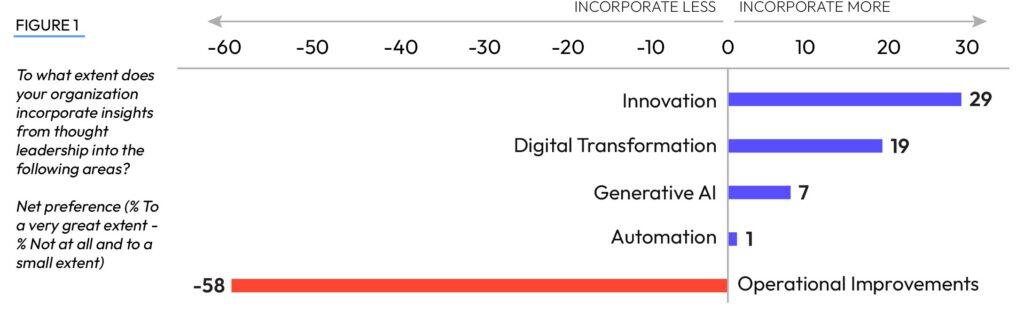
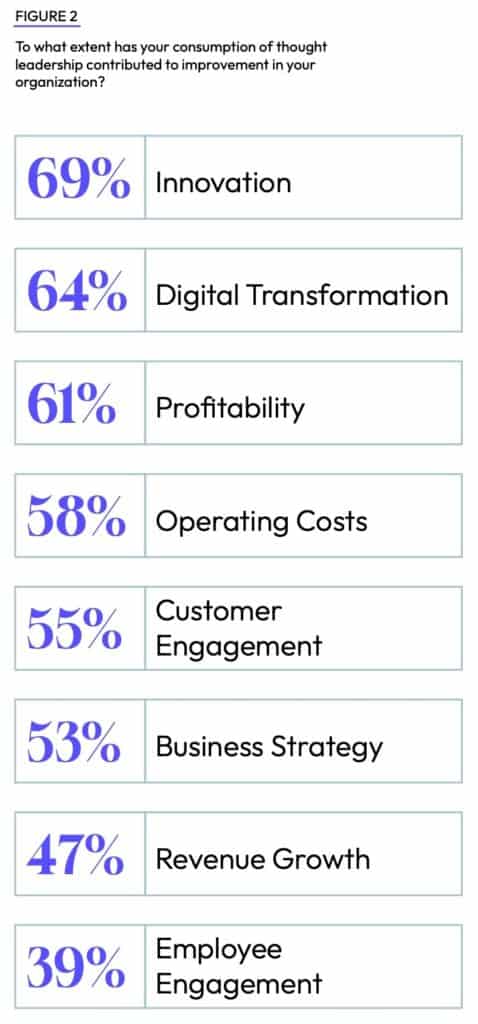
Specifically, almost 7 in 10 (69%) executives say they have used thought leadership to improve innovation in their organization and nearly two-thirds (64%) agree that thought leadership has helped catalyze digital transformation. More than half have used it to address customer engagement, operating costs, profitability, and business strategy.
How do executives choose which thought leadership they will trust? Quality is a critical factor in assessing the value of thought leadership. The great majority (87%) of executives who consume thought leadership say they’re likely to purchase business services from an organization based on the quality of their thought leadership. That’s important because 95% say they made a purchase decision based on thought leadership in the last quarter.
The significance of this statistic can’t be overemphasized. Executives are purchasing from organizations that have earned a reputation for quality. More than two-thirds of thought leadership consumed (71%) is from current vendors and just 20% from prospective vendors.
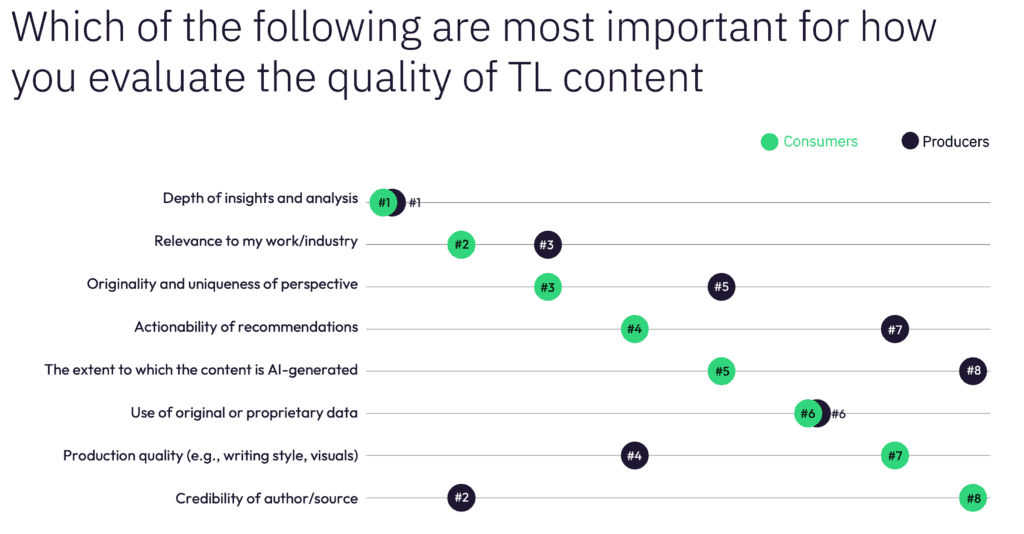
Beyond that, the way consumers and producers define quality is only partially aligned. More than 70% of executive consumers ranked originality, delivering a unique perspective, and use of proprietary data as key characteristics of thought leadership quality, compared to a lower proportion of producers.
To lock in this kind of loyalty, both thought leadership consumers and producers agree that depth of analysis and relevance rank as the top measures of quality.
THOUGHT LEADERSHIP PRODUCER PERSPECTIVE
“Quality is central to our thought leadership strategy,” says Anthony Marshall, Global Leader of the IBM Institute for Business Value (IBV) and founding Board Member of the GTLI. “But what do we mean by quality? It encapsulates the entire gamut of the content creation value chain.”
ANTHONY MARSHALL
GLOBAL LEADER OF THE IBM INSTITUTE FOR BUSINESS VALUE (IBV) | FOUNDING BOARD MEMBER OF GTLI
THOUGHT LEADERSHIP CONSUMER PERSPECTIVE
“For me, [the] most value lies in seeing a roadmap of practical steps toward an end state. Most leaders can see end goals, but to clarify how to take the organization from where it is toward that future is where thought leadership can deliver real value.”
HIROSHI OKUYAMA
CHIEF DIGITAL OFFICER (CDO) | MEMBER OF THE BOARD | YANMAR HOLDINGS
Creators tend to underestimate the importance of actionability and the use of AI. Instead, they fixate on production quality, style, and author credibility, which matter less to executive consumers.
Theories, frameworks, matrices, and models can be useful tools, but only if producers can show their application to real use cases and client experience. And however high the production value, if the content doesn’t offer clear actionable advice, it’s not valued by the executives who rely on thought leadership for business insight. Recommendations need to offer specific, clear, and concrete steps that help the reader move their organization forward.
Rising to the quality challenge
Producers face different challenges depending on their size and maturity. While most cite lack of funding and associated issues, such as insufficient headcount and lack of employee skills, the overwhelming hurdle for the largest and most mature organizations is complex governance.
For the full cohort of TL producers, lack of funding tops the list (49%) with difficulty aligning diverse audience interests a close second (47%).
Challenges that spring from funding like insufficient headcount (44%) and lack of employee skills (41%) were key challenges.
However, for GTLI board members, the overwhelming top challenge is complex governance (80%), reflecting the size and indeed complexity of many of those firms.
stakeholder support
AI for me, but not for thee
Business leaders have a generally negative view of producers using GenAI to create thought leadership: almost seven in 10 (69%) say its use would negatively impact their appetite to engage with the producing organization and 74% say it would negatively impact a purchase decision. But this skepticism about AI isn’t universal. While business leaders don’t seem to want their thought leadership generated by AI, they do use it themselves.
As Amy Whelus, Chief Technology and Information Officer, Gigapower and VP Architecture and Strategic Planning, AT&T, puts it, thought leadership produced by GenAI “may be perceived as repackaged or curated from existing sources rather than unique insights.”
Consumers “have increasingly cautious—one might say realistic—expectations around AI,” says Fiona Czerniawksa, CEO of Source Global Research. “They still assume that GenAI will enable them to do most of the basic analysis they would have hired consulting firms to carry out in the past but, if anything, the shortcomings of GenAI have made them more conscious of the importance of ‘proper’ expertise.”
Executives’ cautious approach to thought leadership created with AI extends to the use of synthetic data. Synthetic data sampling refers to the practice of using existing data and applying the attributes of real responses to a larger sample across more parameters. This generates additional “synthetic” data, or artificially generated information that mimics the patterns and statistical properties of real-world data, but contains no actual, individual records.
THOUGHT LEADERSHIP ANALYST PERSPECTIVE
“[Thought leadership produced by GenAI] may be perceived as repackaged or curated from existing sources rather than unique insights.”
AMY WHELUS
CHIEF TECHNOLOGY AND INFORMATION OFFICER, GIGAPOWER | VP
ARCHITECTURE AND STRATEGIC PLANNING | AT&T
THOUGHT LEADERSHIP CONSUMER PERSPECTIVE
“[Consumers] have increasingly cautious—one might say realistic—expectations around AI. They still assume that GenAI will enable them to do most of the basic analysis they would have hired consulting firms to carry out in the past but, if anything, the shortcomings of GenAI have made them more conscious of the importance of ‘proper’ expertise.”
FIONA CZERNIAWKSA
CEO | SOURCE GLOBAL RESEARCH
In theory, synthetic data can scale responses from smaller data sets, allowing for insights to be generated more quickly and cheaply. Today, synthetic data is used mainly to train machine learning models, serving to feed the voracious appetite of ever-larger AI models. Perhaps this is why Gartner predicts that up to 80% of the data used for training AI will be synthetic by 2028.5
Many thought leadership producers are already experimenting with synthetic data. As Francis Hintermann, Global Research Executive Director at Accenture, notes: “Synthetic data is rapidly emerging as a fast and cost-effective research approach, enabling the production of high-quality insights across an increasingly broad range of topics.”
Even as we see an increase in the use of synthetic data in thought leadership, 85% of executives who consume thought leadership say they do not trust the insights it helps generate. And 82% say they would not be willing to make business decisions based on AI-generated insights based on synthetic data.
Although executives seem to want to distance themselves from AI-generated thought leadership, they rely on AI tools for many business functions: a notable contradiction that thought leadership producers will have to reconcile as they move through the next few years.
Business leaders are adopting AI across their organizations to streamline workflows and change business models. And many plan to use their own AI tools to generate business insights, with 82% predicting that AI will replace some proportion of the thought leadership they would have sourced externally by 2027—posing a potential challenge for thought leadership producers to up their game and adapt the way they operate.
Executives who consume thought leadership also say they will leverage AI’s power to curate, personalize, and synthesize what they read. More than nine out of 10 business leaders say they are interested in using AI to access thought leadership. They are particularly interested in using it to collect tailored insights. Almost all consumers (94%) say they expect to be able to access a producer’s full portfolio of thought leadership using AI tools and 95% say they want AI to search across producers’ portfolios to integrate content for them.

Synthetic Data Sampling
refers to the practice of using existing data and applying the attributes of real responses to a larger sample across more parameters. This generates additional “synthetic” data, or artificially generated information that mimics the patterns and statistical properties of real-world data, but contains no actual, individual records.
They will not have long to wait. A resounding majority (92%) of organizations that produce thought leadership are already adapting their content and formats to accommodate AI tools to ensure that their content remains discoverable through AI answer engines. They also are embedding helpful chatbots on their websites. For example, McKinsey and the IBM IBV have installed AI assistants that can deliver insights from their digital libraries of thought leadership. Lucia Rahilly, McKinsey’s Global Editorial Director and Deputy Publisher, says the Ask McKinsey assistant has delivered meaningful differentiation for users since its debut last spring. “One user called it a ‘secret weapon’ for research and discovery,” she says, noting that additional personalization and other features are forthcoming this year.
1 https://the-decoder.com/anthropics-marketing-department-opens-zero-slop-zone-in-new-york/
2 https://www.merriam-webster.com/wordplay/word-of-the-year
3 https://graphite.io/five-percent/more-articles-are-now-created-by-ai-than-humans
4 Client Perceptions of Thought Leadership, Source Global Research, June 2025
5 CIO Magazine. “Synthetic data’s fine line between reward and disaster.” 21 May 2025.
https://www.cio.com/article/3986687/synthetic-datas-fine-line-between-reward-and-disaster.html