

Executive Summary
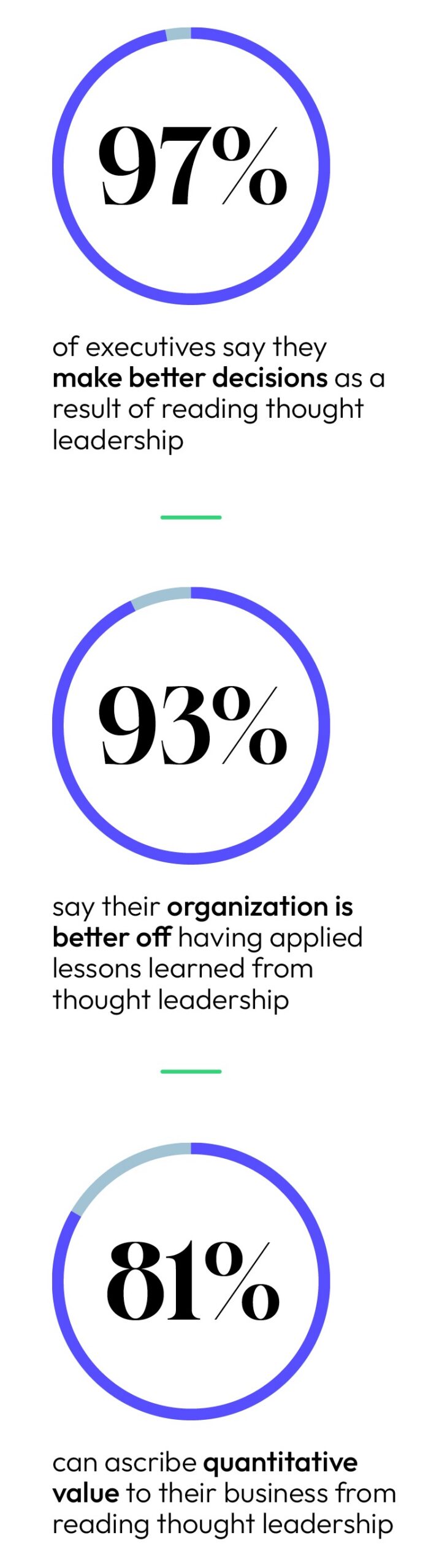
Thought leadership has never been more important: 97% of business executives say they make better decisions as a result of reading it, 93% say their organizations directly benefit, and 81% say they can quantify the value thought leadership delivers to their organizations.
These are powerful statistics to be sure, yet thought leadership is at a crossroads. Nearly all organizations that produce thought leadership (96%) say that artificial intelligence (AI) is disrupting the industry.
AI is revolutionizing research methods, data analytics, and consumption patterns. Executives who use thought leadership are also in the midst of profound change driven by AI as they demand transparency and new ways to engage. And despite the proliferation of “AI slop,” 85% of CxOs say they expect to consume as much or more thought leadership in the next two years as they do today. More than two-thirds (69%) say the use of AI has a negative influence on their decision to engage with a producing organization.
At this important juncture, the Global Thought Leadership Institute (GTLI) has undertaken extensive research to determine the role of thought leadership in bringing big ideas to the boardroom; how AI is changing the way leaders consume and firms produce insights; and whether human judgment still has a part to play in content creation. Based on survey data from 1,000 executives who consume thought leadership (consumers) and 359 individuals who work in organizations that produce thought leadership (producers), we analyze how the thought leadership landscape is changing and what it will take to preserve the importance, influence, and impact of thought leadership in the future.
A new era for thought leadership
In October 2025, a pop-up space labeled “Zero Slop Zone” appeared in New York City’s West Village.1 The pop-up’s 5,000 visitors were invited to leave their electronic devices at the door and don free “thinking” caps while reading hard copies of a 15,000-word essay. This was no marketing ploy by a techno-pessimistic Luddite but rather an effort by Anthropic, creator of Claude and rival to ChatGPT. We must, the marketing campaign urged, “keep thinking.”
In 2025, dictionary publisher Merriam-Webster crowned “slop” its word of the year: “digital content of low quality that is produced, usually in quantity, by means of artificial intelligence.”2 Perhaps not a surprise since, a year earlier, web research company Graphite noted that AI-generated articles outnumbered content created by humans.3
Even so, AI is being embraced by both consumers and producers of thought leadership in specific instances. For example, 91% of executives say they would like AI tools to help them access thought leadership more effectively. And 93% of the largest and most mature thought leadership organizations are using generative AI (GenAI) for some aspects of thought leadership creation. Only about half (54%) of smaller producers have yet to embed AI in their research and creation processes.
While AI offers significant promise, there is also significant peril. Thought leadership producers must steer a course between the two. They are charged with continuing to produce the distinctive, evidence-based insights executives need and they must improve productivity, streamline workflows, and cut costs.
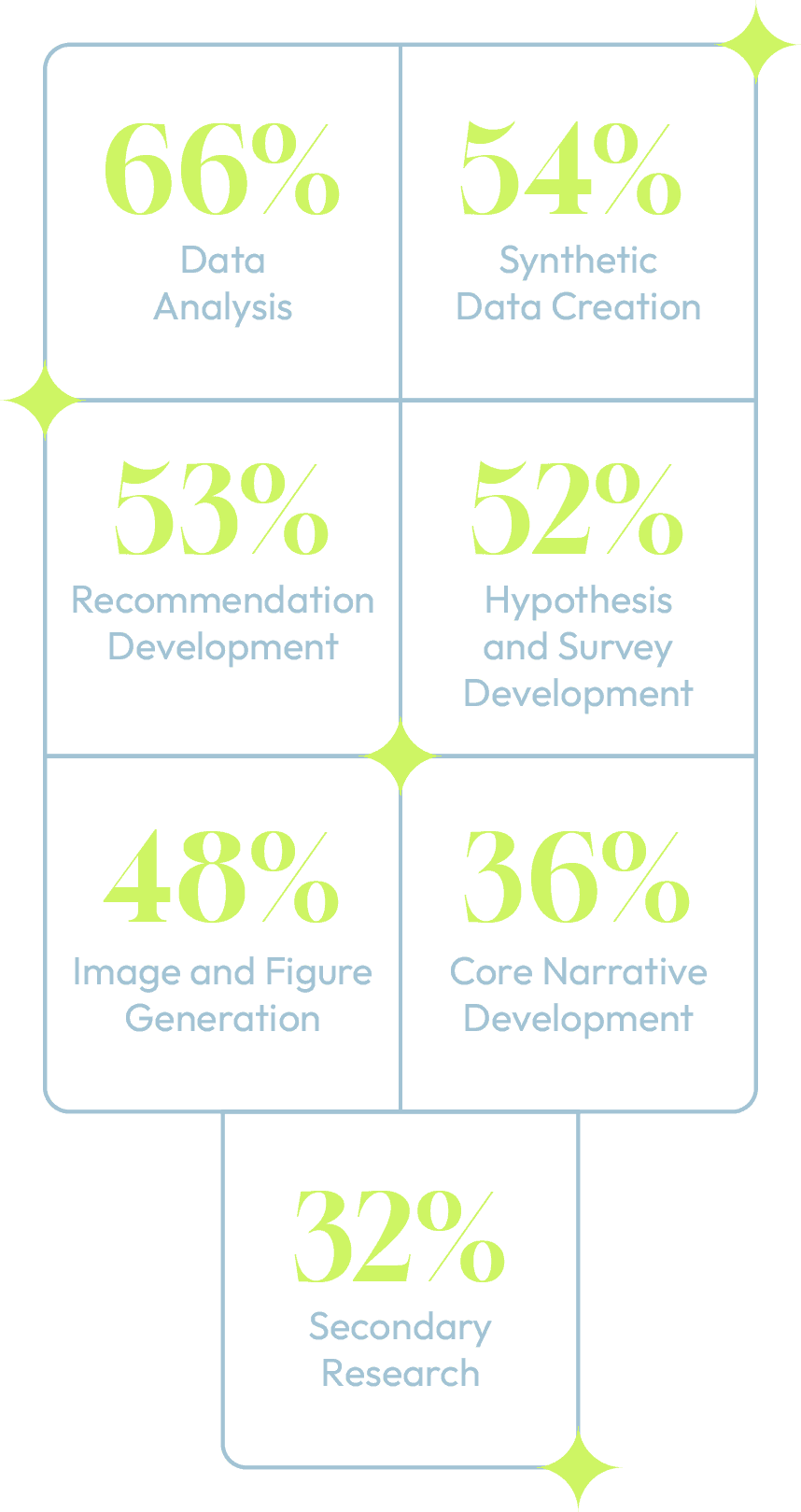
The large thought leadership producers who leverage AI most often are using it in ways that augment, rather than dilute, the quality of their insights. Instead of replacing human experts, they are focusing on white space analysis, hypothesis refinement, research and data collection and analysis, derivative content development, data visualization, and search assistants.
Whether you are a producer or consumer of thought leadership, dramatic changes are underway in how thought leadership is created, discovered, curated, and shared. For those looking to differentiate the best thought leadership and ensure its continued value to executives, understanding these forces and using AI tools in a trustworthy and intelligent manner is essential.
Executives want relevance and actionable substance; producers worry more about polish
As organizations everywhere face enormous pressure to change and innovate, executives rely on thought leadership for insights. Research by Source Global Research shows that consumption of thought leadership increases as the operating environment becomes more complex.4 When the business environment moves from being simply uncertain to predictably unreliable, executives turn to thought leadership as a trusted advisor.
With all the media attention on AI, it’s not a surprise that today’s business leaders have a strong appetite for thought leadership insights on innovation, transformation, and technology—but rather less for ongoing operational improvements.
Thought Leadership Producer Perspective
“The value of thought leadership is in its unique blend of objective, quantitative research filtered by client experience.”
LISA HIGGINS
PRESIDENT AND CEO | APQC
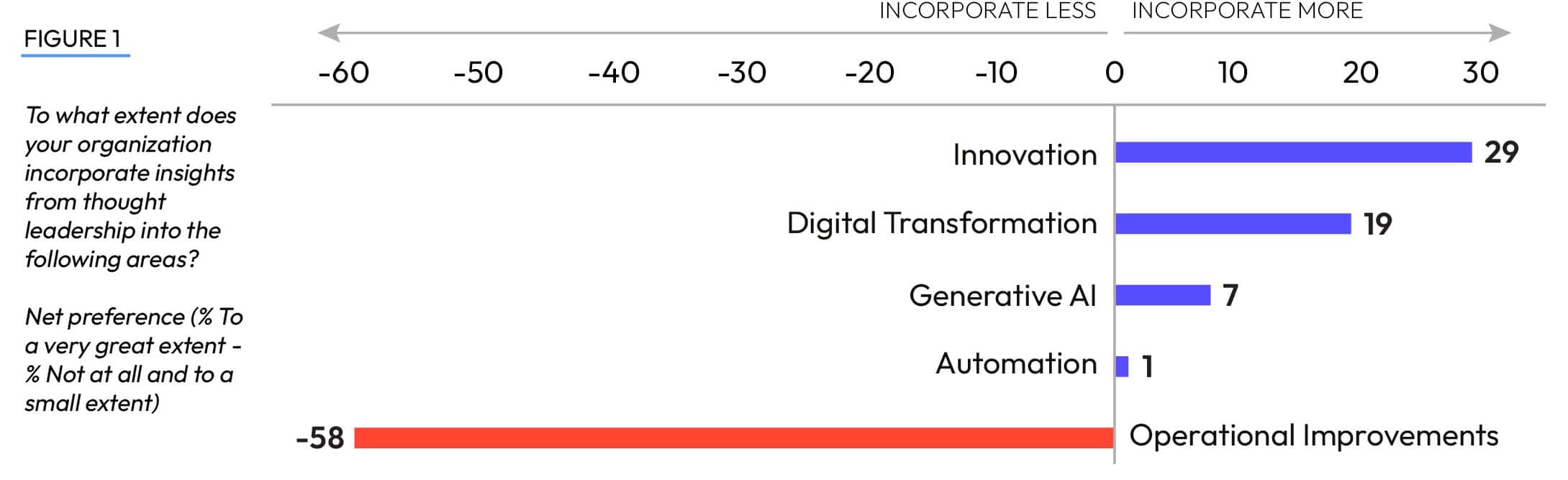
Specifically, almost 7 in 10 (69%) executives say they have used thought leadership to improve innovation in their organization and nearly two-thirds (64%) agree that thought leadership has helped catalyze digital transformation. More than half have used it to address customer engagement, operating costs, profitability, and business strategy.
How do executives choose which thought leadership they will trust? Quality is a critical factor in assessing the value of thought leadership. The great majority (87%) of executives who consume thought leadership say they’re likely to purchase business services from an organization based on the quality of their thought leadership. That’s important because 95% say they made a purchase decision based on thought leadership in the last quarter.

The significance of this statistic can’t be overemphasized. Executives are purchasing from organizations that have earned a reputation for quality. More than two-thirds of thought leadership consumed (71%) is from current vendors and just 20% from prospective vendors.
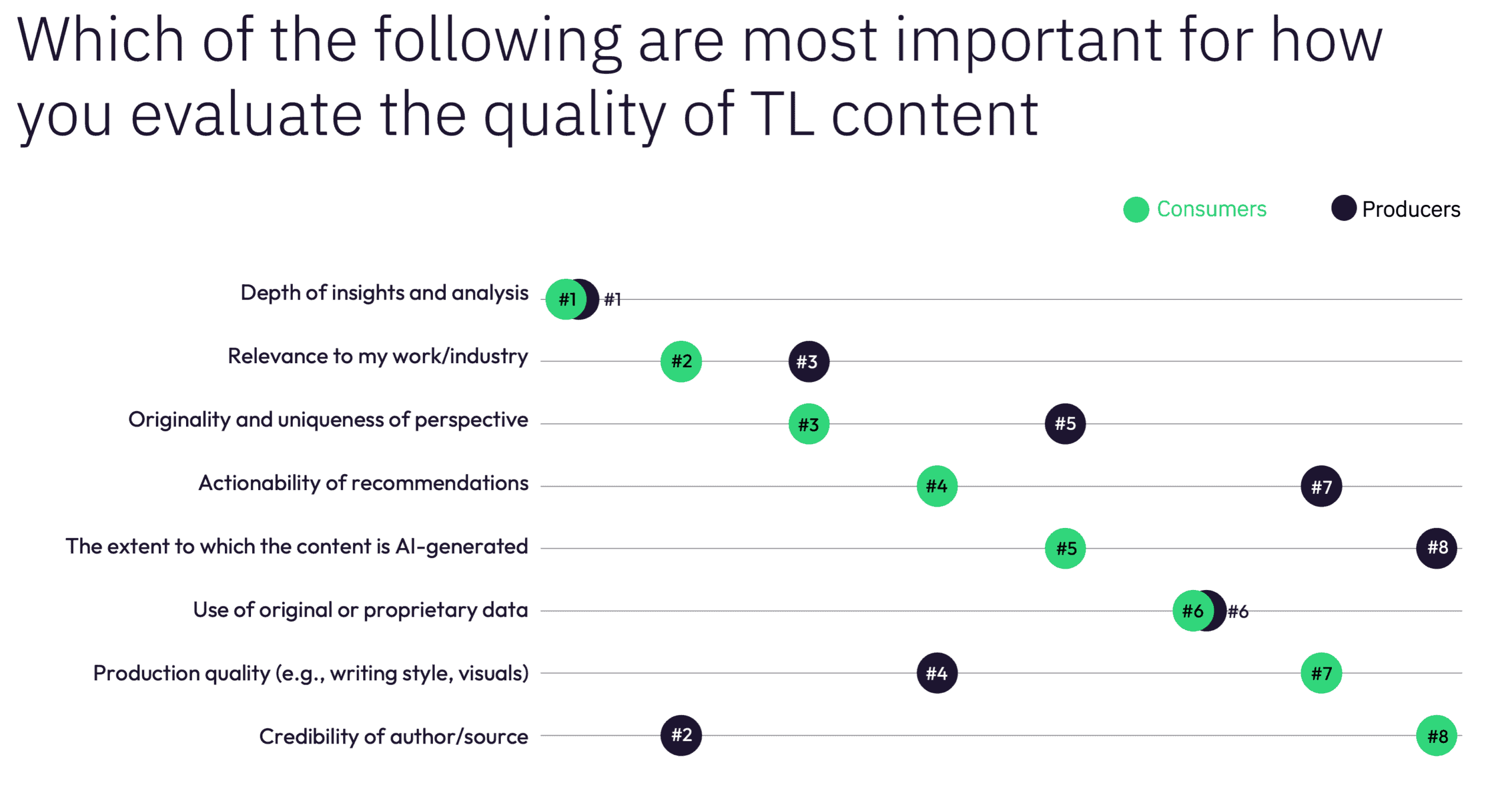
To lock in this kind of loyalty, both thought leadership consumers and producers agree that depth of analysis and relevance rank as the top measures of quality.
Beyond that, the way consumers and producers define quality is only partially aligned. More than 70% of executive consumers ranked originality, delivering a unique perspective, and use of proprietary data as key characteristics of thought leadership quality, compared to a lower proportion of producers.
Thought Leadership Producer Perspective
“Quality is central to our thought leadership strategy. But what do we mean by quality? It encapsulates the entire gamut of the content creation value chain.”
ANTHONY MARSHALL
GLOBAL LEADER OF THE IBM INSTITUTE FOR BUSINESS VALUE (IBV)
AND FOUNDING BOARD MEMBER OF GTLI
Thought Leadership Consumer Perspective
“For me, [the] most value lies in seeing a roadmap of practical steps toward an end state. Most leaders can see end goals, but to clarify how to take the organization from where it is toward that future is where thought leadership can deliver real value.”
HIROSHI OKUYAMA
CHIEF DIGITAL OFFICER (CDO) AND MEMBER OF THE BOARD | YANMAR HOLDINGS
Creators tend to underestimate the importance of actionability and the use of AI. Instead, they fixate on production quality, style, and author credibility, which matter less to executive consumers.
Theories, frameworks, matrices, and models can be useful tools, but only if producers can show their application to real use cases and client experience. And however high the production value, if the content doesn’t offer clear actionable advice, it’s not valued by the executives who rely on thought leadership for business insight. Recommendations need to offer specific, clear, and concrete steps that help the reader move their organization forward.
Rising to the quality challenge
Producers face different challenges depending on their size and maturity. While most cite lack of funding and associated issues, such as insufficient headcount and lack of employee skills, the overwhelming hurdle for the largest and most mature organizations is complex governance.
For the full cohort of TL producers, lack of funding tops the list (49%) with difficulty aligning diverse audience interests a close second (47%).
Challenges that spring from funding like insufficient headcount (44%) and lack of employee skills (41%) were key challenges.
However, for GTLI board members, the overwhelming top challenge is complex governance (80%), reflecting the size and indeed complexity of many of those firms.
stakeholder support
AI for me, but not for thee
Business leaders have a generally negative view of producers using GenAI to create thought leadership: almost seven in 10 (69%) say its use would negatively impact their appetite to engage with the producing organization and 74% say it would negatively impact a purchase decision. But this skepticism about AI isn’t universal. While business leaders don’t seem to want their thought leadership generated by AI, they do use it themselves.
As Amy Whelus, Chief Technology and Information Officer, Gigapower and VP Architecture and Strategic Planning, AT&T, puts it, thought leadership produced by GenAI “may be perceived as repackaged or curated from existing sources rather than unique insights.”
Consumers “have increasingly cautious—one might say realistic—expectations around AI,” says Fiona Czerniawksa, CEO of Source Global Research. “They still assume that GenAI will enable them to do most of the basic analysis they would have hired consulting firms to carry out in the past but, if anything, the shortcomings of GenAI have made them more conscious of the importance of ‘proper’ expertise.”
Executives’ cautious approach to thought leadership created with AI extends to the use of synthetic data. Synthetic data sampling refers to the practice of using existing data and applying the attributes of real responses to a larger sample across more parameters. This generates additional “synthetic” data, or artificially generated information that mimics the patterns and statistical properties of real-world data, but contains no actual, individual records.
Thought Leadership Consumer Perspective
"[Thought leadership produced by GenAI] may be perceived as repackaged or curated from existing sources rather than unique insights.”
AMY WHELUS
CHIEF TECHNOLOGY AND INFORMATION OFFICER, GIGAPOWER AND VP
ARCHITECTURE AND STRATEGIC PLANNING | AT&T
Thought Leadership Analyst Perspective
"[Consumers] have increasingly cautious—one might say realistic—expectations around AI. They still assume that GenAI will enable them to do most of the basic analysis they would have hired consulting firms to carry out in the past but, if anything, the shortcomings of GenAI have made them more conscious of the importance of ‘proper’ expertise.”
FIONA CZERNIAWKSA
CEO | SOURCE GLOBAL RESEARCH
In theory, synthetic data can scale responses from smaller data sets, allowing for insights to be generated more quickly and cheaply. Today, synthetic data is used mainly to train machine learning models, serving to feed the voracious appetite of ever-larger AI models. Perhaps this is why Gartner predicts that up to 80% of the data used for training AI will be synthetic by 2028.5
Many thought leadership producers are already experimenting with synthetic data. As Francis Hintermann, Global Research Executive Director at Accenture, notes: “Synthetic data is rapidly emerging as a fast and cost-effective research approach, enabling the production of high-quality insights across an increasingly broad range of topics.”
Even as we see an increase in the use of synthetic data in thought leadership, 85% of executives who consume thought leadership say they do not trust the insights it helps generate. And 82% say they would not be willing to make business decisions based on AI-generated insights based on synthetic data.
Although executives seem to want to distance themselves from AI-generated thought leadership, they rely on AI tools for many business functions: a notable contradiction that thought leadership producers will have to reconcile as they move through the next few years.
Business leaders are adopting AI across their organizations to streamline workflows and change business models. And many plan to use their own AI tools to generate business insights, with 82% predicting that AI will replace some proportion of the thought leadership they would have sourced externally by 2027—posing a potential challenge for thought leadership producers to up their game and adapt the way they operate.
Executives who consume thought leadership also say they will leverage AI’s power to curate, personalize, and synthesize what they read. More than nine out of 10 business leaders say they are interested in using AI to access thought leadership. They are particularly interested in using it to collect tailored insights. Almost all consumers (94%) say they expect to be able to access a producer’s full portfolio of thought leadership using AI tools and 95% say they want AI to search across producers’ portfolios to integrate content for them.

Synthetic Data Sampling
refers to the practice of using existing data and applying the attributes of real responses to a larger sample across more parameters. This generates additional “synthetic” data, or artificially generated information that mimics the patterns and statistical properties of real-world data, but contains no actual, individual records.
They will not have long to wait. A resounding majority (92%) of organizations that produce thought leadership are already adapting their content and formats to accommodate AI tools to ensure that their content remains discoverable through AI answer engines. They also are embedding helpful chatbots on their websites. For example, McKinsey and the IBM IBV have installed AI assistants that can deliver insights from their digital libraries of thought leadership. Lucia Rahilly, McKinsey’s Global Editorial Director and Deputy Publisher, says the Ask McKinsey assistant has delivered meaningful differentiation for users since its debut last spring. “One user called it a ‘secret weapon’ for research and discovery,” she says, noting that additional personalization and other features are forthcoming this year.
How AI is used is more important to business leaders than the frequency or extent of its use. As content creators find more ways to harness GenAI, the question of transparency is becoming existential. Yet only 14% of producers always disclose the use of AI in their insights and only just over half (52%) mention it when GenAI has played a major role in creating content. More than a third (34%) have either no policy or simply don’t disclose whether AI has been used in the creation of their thought leadership.
Thought Leadership Consumer Perspective
“While GenAI tools can help accelerate the production of thought leadership, they cannot replace the need for human experts to deliver truly differentiated insights. It takes the right combination of critical thinking, understanding how to ask the right questions to pull out responses, and creativity to bring it all together into breakthrough concepts.”
KAREN FELDMAN
CHIEF MARKETING OFFICER | IRON MOUNTAIN
Thought Leadership Consumer Perspective
“The trick is to create a best-case future in which thought leaders are empowered to spend more time thinking and presenting and less time mechanically turning those thoughts into 15 different content outputs.”
MATT CARMICHAEL
SVP, CONSUMER TRENDS THOUGHT LEADERSHIP | IPSOS MORI
The impact of first-rate thought leadership, when you get it right
In an analysis described in The ROI of Thought Leadership, the book’s authors report that thought leadership drives USD265 billion each year in corporate spending.6 And the current GTLI study corroborates the direct influence of thought leadership on buyer choice: more than one-third of CxOs in this survey said they made a purchase decision based on thought leadership in the past month, with an additional 57% doing so in the past three months. By contrast, just 1% say thought leadership has never influenced a buying decision.
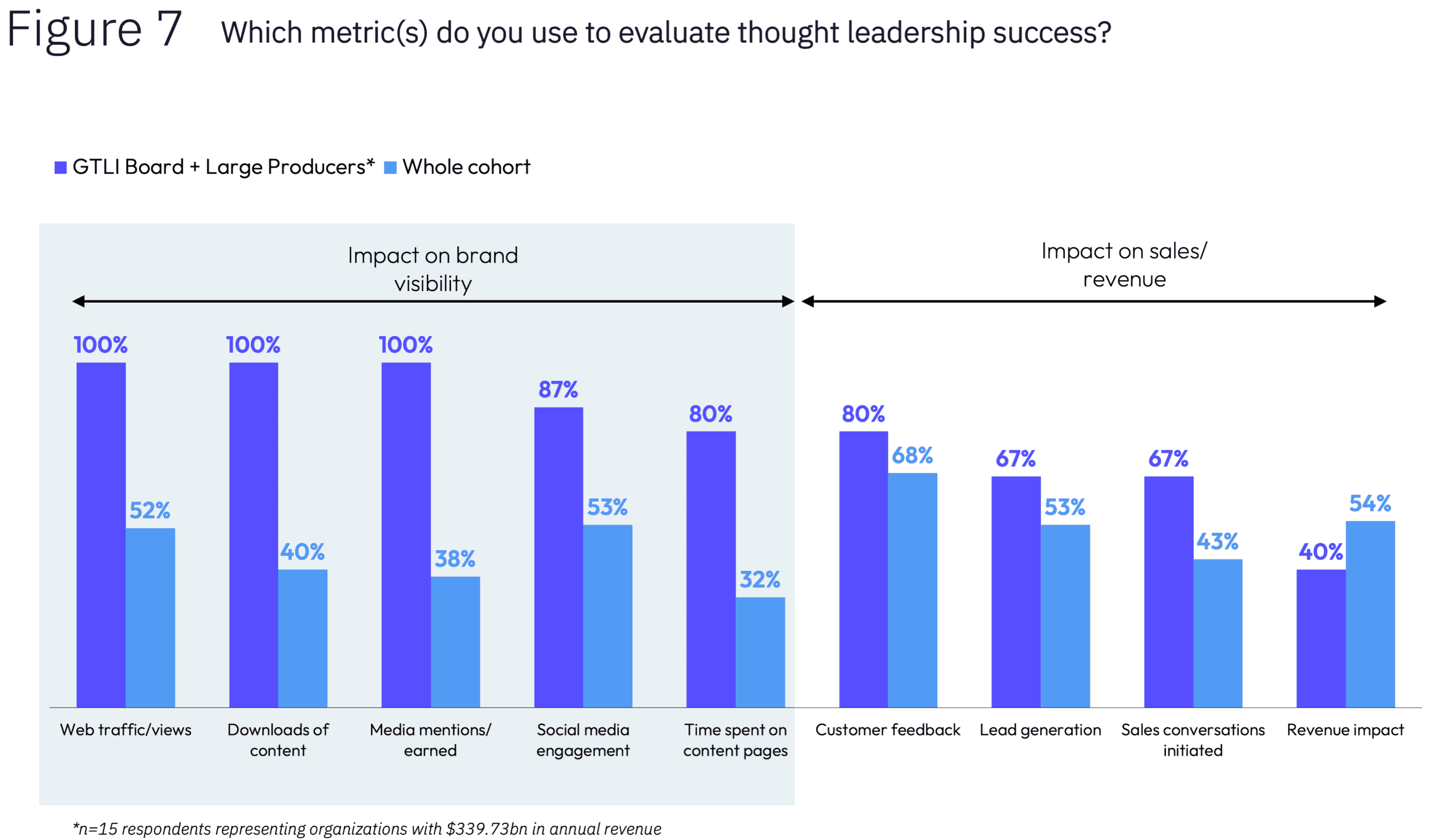
Almost all (95%) of thought leadership producers have a formal process for measuring the performance of their content. Larger and more mature producers tend to emphasize brand visibility metrics including web traffic, downloads, and earned media engagement, while the total respondent set prioritizes commercial impact, including lead generation and sales conversions. But there is still much room for improvement and alignment in the measurement of thought leadership impact.
Thought Leadership Producer Perspective
“Until we are able to definitively quantify the value of thought leadership, it will continue to be perceived as a cost center and we’ll continue having to justify our existence. The data in our book provides the first credible ROI calculation, showing that thought leadership delivers a return of 156%—16 times higher than a traditional marketing campaign. That’s powerful evidence.”
CINDY ANDERSON
CMO OF THE IBM IBV, CO-AUTHOR OF THE ROI OF THOUGHT LEADERSHIP AND
MEMBER OF THE GTLI ADVISORY BOARD
AI is changing how executives engage with thought leadership, enabling deeper, more personalized engagement, which will change the way thought leadership is measured. Legacy models of broadcasting to large, unidentified populations have been replaced with content that is sharply targeted at specific C-suite roles in specific sectors or sub-sectors. Here, hits and clicks are replaced by more sophisticated measurements of engagement, including traceable actions.
Measuring performance is only half the story, however. Most organizations will need to gauge the return on their investment and, by extension, compare that ROI to other marketing activities. Linking content performance to business outcomes is, for the biggest and most mature thought leadership producers, the core challenge.
This research from the Global Thought Leadership Institute reveals that thought leadership remains a powerful driver of executive decision-making and organizational value. Nearly all surveyed leaders attributed tangible business benefits and revenue impact to high-quality insights. However, the practice is at a crossroads as AI disrupts both the production and consumption of thought leadership: while most executives want AI tools to help them access and personalize insights, they distrust AI-generated content and synthetic data, emphasizing the enduring need for human expertise, transparency, and actionable advice.
Originality, relevance, and depth of analysis are key to earning executive trust and loyalty and driving business impact. The following action guide for executives who consume thought leadership, along with large and smaller thought leadership producers, offers practical guidance that will continue to expand influence of thought leadership in a rapidly changing landscape.
Thought Leadership Producer Perspective
“For larger firms, brand is paramount. It leads to stronger relationships and revenue. The journey from one end to the other may just be longer and therefore more difficult to track, which is why the biggest consulting firms focus so obsessively on brand indicators.”
JEFF POTTER
HEAD OF ADVISORY INSIGHTS | KPMG AND
MEMBER OF GTLI ADVISORY BOARD
Action guides
Action Guide For Thought Leadership Consumers

Prioritize thought leadership sources that conduct original research and interrogate data to explore emerging trends, tackle persistent pain points, and test assumptions—not those that simply push out glossy reports.
-
Look for thought leadership from organizations that invite interaction, dialogue, or advice that helps you apply the insights directly to your business challenges.
-
Expect transparent, human‑led thinking—augmented by AI. Favor thought leadership that uses AI to sharpen research, personalize insights, or accelerate analysis, while still grounding arguments in expert human judgment.
-
Search for specific answers to your most burning questions. Prioritize content that clarifies decisions, uncovers risks, or reveals new opportunities for your organization. Don’t be satisfied with whatever’s at the top of the search results.
-
Make sure you walk away knowing what to do next. Ignore content that is polished but impractical. Gravitate toward thought leadership that offers practical tools, scenarios, and steps you can apply today—and shows you how to grow.

Action guide for larger thought leadership producers:
-
Identify areas you can own and connect to your brand—then create content that is unmatched. Just as business strategy focuses on white space, so should your content strategy. Use original, credible thought leadership to start a conversation your audience is eager for.
-
Build a dynamic insight platform, not a static library. Shift from producing publications to creating an interactive digital environment where users can explore the latest trends, interrogate data visually, and access personalized insights.
-
Deliver a personal touch. Move beyond pushing reports to enable deeper, two‑way engagement that helps users work with your ideas, not just read them. Build active partnerships with account teams to make targeted thought leadership an ongoing client benefit—not just a lure for new prospects.
-
Use fit-for purpose AI. Develop AI capabilities that are distinctive to your organization and embed them as a core competency to unlock insights that were not previously possible. Tailor AI assistants and agents to complete tasks to your unique specifications—using proprietary data, style guides, and customer information that could never be leveraged with an external AI solution. Employ AI to enhance the depth, relevance, and personalization of your thought leadership—not to generate it wholesale.
-
Redefine success. Replace volume‑based metrics such as clicks and downloads with measures of true business impact: influence on clients, strategic outcomes, and revenue contribution.

Action guide for smaller thought leadership producers:
-
Answer the questions stumping your audience today—and point out the challenges on the horizon. Don’t just talk about what’s most important to your business. Stand out by showing you understand what your customers really
-
Don’t surrender AI answer engines to the big dogs. The more targeted your content, the better chance you have of appearing in AI-powered search summaries. Structure web content to be easily scannable, highlighting fresh insights from credible sources and original research.
-
Focus on quality, not quantity, to engage your audience. Instead of pushing out more reports, focus on starting meaningful conversations. Use targeted content in short briefings, workshops, and interactive sessions that help executives apply your thinking directly to their biggest pain points.
-
Employ a whole team of AI assistants to scale your impact. AI can help you examine trends broadly and discover where you have something new to say. But fresh ideas are uniquely human. Once you know what you want to say, use AI to speed up content production, from survey development and research analysis to narrative development and design, always keeping experts in the driver’s seat.
-
Measure what matters. Track how your work influences decisions, sparks conversations, or brings in new opportunities—not just how many people clicked or downloaded something.

Methodology
To investigate how thought leadership is being consumed and produced, the Global Thought Leadership Institute conducted research based on a dual-perspective approach. The study gathered quantitative data through two distinct, large-scale surveys of consumers and producers of thought leadership.
Thought leadership consumer survey
We surveyed 1,000 C-suite executives from large, enterprise-scale organizations across 18 major industries and 19 countries. The sampling frame was designed to ensure a comprehensive cross-industry view, with significant representation from banking (10%), services (9%), electronics and software (9%), telecommunications (7%), government (6%), and a combined consumer sector (retail at 5% and consumer products at 5%). Other substantial sectors included insurance (6%), transportation (6%), chemicals (6%), automotive (6%), and energy and utilities (5). Geographically the distribution was as follows: North America (36%), Europe (28%), Asia-Pacific (27%), Central and South America (5%), and Middle East & Africa (4%). The respondent pool was composed of senior leadership to provide a strategic, organizational-level perspective. The sample included the following distribution of key roles: Chief Executive Officers (35%), Chief Financial Officers (13%), Chief Information Officers (11%), Chief Technology Officers (20%), Chief Marketing Officers (10%), Chief Human Resources Officers (5%), and Chief Data Officers (6%). The organizations represented were substantial in scale, with an average annual revenue of approximately USD20 billion, underscoring that the findings reflect the priorities and challenges of major corporations.
Thought leadership producer survey
In collaboration with Phronesis, we conducted a survey of 359 different thought leadership producing organizations from 10 different countries. The sample included 77 respondents from organizations with a revenue of more than USD5 billion, ensuring we included most of the major global thought leadership producing organizations. The respondents covered different roles in thought leadership production as follows: Executive leadership (38%), research and analysis (16%), strategy and planning (16%), distribution and marketing (14%), content creation and writing (11%), and operations (6%). The average respondent had 10 years of thought leadership experience. In this report, the “largest and most mature” or “larger and more mature” producers refers to a sample of 15 organizations surveyed anonymously from the GTLI Board and GTLI Top 100.
Analytical approach
The analysis proceeded in two key stages. First, descriptive statistics, including frequency analyses and demographic cuts, were used to identify primary trends and establish a baseline understanding of the data from both populations. Second, we compared and contrasted key data points in the two surveys to ascertain where there are tenstions or different expectations between producers and consumers, e.g. in terms of factors deemed important for high quality thought leadership or the role of AI in creating and accessing thought leadership.
Acknowledgements
The Global Thought Leadership Institute Board of Advisers would like to thank the following organizations for their exceptional support in the creation of this report:
- The IBM Institute for Business Value (IBV)
- EY
- Phronesis Partners
- Weber Shandwick
Footnotes
1 https://the-decoder.com/anthropics-marketing-department-opens-zero-slop-zone-in-new-york/
2 https://www.merriam-webster.com/wordplay/word-of-the-year
3 https://graphite.io/five-percent/more-articles-are-now-created-by-ai-than-humans
4 Client Perceptions of Thought Leadership, Source Global Research, June 2025
5 CIO Magazine. “Synthetic data’s fine line between reward and disaster.” 21 May 2025.
https://www.cio.com/article/3986687/synthetic-datas-fine-line-between-reward-and-disaster.html
6 Cindy Anderson and Anthony Marshall, The ROI of Thought Leadership, Wiley, 2025